Plasma Analysis with Plasma Probes and Retarding Field Analysers
Principle of Plasma Analysis with plasma probes and Retarding Field Analysers
Plasma probes are one of the oldest measuring techniques for gas discharges and have a history of more than 100 years. They can be used as Langmuir probes, measuring plasma properties like electron density and electron energy at the plasma itself, or as plasma sheet probes arranged at the plasma walls (or substrate position) to characterize the plasma from the plasma sheet, which influences thin film deposition processes significantly.
Retarding Field Analysers (RFA) are used for plasma- and ion beam analysis since 50 years. They consist of an ion optical systems with several isolated grids to extract from a plasma positive ions or negative ions/electrons and to measure their energy distribution by a retarding field.
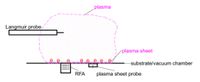
Principle of plasma analysis by Langmuir probes, plasma sheet probes and Retarding Field Analysers
The device "PlasmaMon" from Jenion works with all three kinds of plasma probes. All probes have to be installed at the vacuum chamber, mostly at customer specified positions. At the electrical vacuum feedtroughs filter circuits for suppressing Radio Frequency are installed. So with this probes plasma analysis can be carried out at plasma excitation frequencies ranging from DC up to 2.45 GHz (microwave plasma).
All probes analyse the plasma in respect to ground. Because the measuring principle is based on DC-currents, the probes only work at plasmas without deposition of isolating layers (e.g. like oxide- or nitride deposition by sputtering or PE CVD).
Of course also broad ion beams can be analysed with plasma sheet probes and Retarding Field Analysers.
The PlasmaMon from Jenion measures in parallel with 16 plasma probes. By this way plasma properties over larger dimensions can be measured simultaneously (e.g. to measure the plasma homogeneity over a larger substrate).
The dimensions of the linear plasma probes range from 16 x 10mm = 160 mm up to 16 x 65 mm = 1040 mm. With this dimensions most plasmas can be analysed.
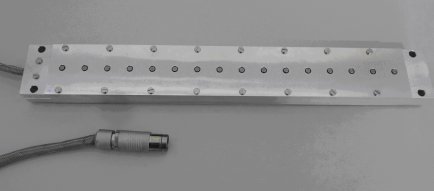
Plasma sheet probe with 16 probes at 20 mm distance (-->measuring length 320 mm)
The Retarding Field Analyser consists of five laser cutted stainless steel plates with 0.25 mm thickness, isolated by ceramic plates of 0.25 mm thickness. So the ion path length inside the system is round about 1mm, which means that the RFA can operate at pressures below approx. 0.3 mbar.
It analyses positive ions or negative ions/electrons in an energy range from 0 to 1000 eV. Because of the competitively large analyser area (0.5 to 1 cm2), they are very sensitive. For high plasma currents Retarding Field Analysers can be built with very small analyser area, like for sputtering with current densities up to 10 mAcm-2, where one analyser hole is sufficient.
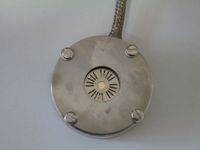
Retarding Field Analyser
The PlasmaMon can be delivered with plasma sheet probes together with the RFA or also with only one probe type. Moreover plasma sheet probes also can be manufactured in customer specified dimensions.
An Electronic Control Unit generates the voltages for the probes and carries out all measurement. It is controlled by a serial port from a PC.
Electronic Control Unit
The Software enables several operation modes:
a) Plasma probe analysis:
- simultaneous measurement of 16 U-I curves,
- ion saturation current profile at 16 points,
- floating voltage profile at 16 points,
- mean ion saturation current over time.
b) Energy Analysis by RFA (0 to 1.000 eV):
- positive Ion Energy Distribution,
- negative Ion Energy/Electron Distribution.
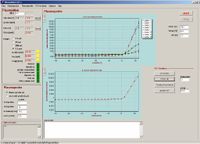
Software for PlasmaMon operating in U-I curve mode
So, if you are interested in plasma probe analysis, ask for an offer according your specification. The actual delivery time of PlasmaMon is between 4 and 6 months.
More information can be found found at the product information below.
 | Download Product Information PlasmaMon 3 Info PlasmaMon 3 2022-1.pdf (1.13MB) |
| Info PlasmaMon 3 2022-1.pdf (1.13MB) |
Some application examples
A lot of different questions regarding plasma properties can be invetigated with PlasmaMon. To give an impression of this some application notes had been created. The application note for download below shows:
a) Analysis of low Frequency plasma (50 kHz) with probes and RFA.
b) Ion energy analysis at Radio Frequency Plasma (13.56 MHz).
c) Broad ion beam analysis of a 40 mm Kaufman ion source with neutralized ion beam.
d) Positive and negative ion energy analysis at ITO sputtering with argon.
e) Plasma homogeneity analysis at a large scale plasma source.
f) Plasma Analysis at an 433 MHz ECR Plasma source
g) Primary Ion Energy Analysis on Magnetron Targets in DC Sputtering
More information can be found at the application note below
| Download Application Note PlasmaMon 3 Appl Note PlasmaMon 3.pdf (1.65MB) |
| Appl Note PlasmaMon 3.pdf (1.65MB) |